


Last Friday, the class watched 2 Philippine documentaries about the natives who live on the island of Palawan, situated at the southern tip of the Philippines. Funded by the Philippine Center for Investigative Journalism, the films set out to uncover the reasons behind the natives' dilemmas and miseries which have haunted them for generations. The indigenous ethno linguistic groups who live on Palawan Island include the the Tagbanua, Palawanon, Tau't, Bato, Visaya, Bugkalot and Igorot tribes. Some live in remote villages in the mountains and cultivated the lands there while seafarers occupy the coastal areas to fish and collect pearls. Apart from farming and gathering forest products, the Tagbanuan people are known to indulge in bird's nest-collecting activities which can provide extra income.
The films first attempt to introduce selected tribes in detail; the introduction may include their history, language, culture, performing arts, religion and economic activities. They do this by sharing knowledge of what they already know about a certain tribe and also excerpts from interviews of natives who provide the film makers with additional information. It is apparent that the director may have only chosen interviewees who could communicate in Tagalog, the basis of the national language of the Philippines, Filipino. The reason for this is perhaps for the convenience of the target audience, the Filipino people. The cameras also caught moments of everyday life: people dancing, eating, talking, smoking, etcetera. Perhaps the director aimed at portraying how simple life is in these parts, where people were care-free and blissful.
The films continue by discussing the grievances of the native people who were negatively affected by the forces of modernisation and how life was getting more complicated. For example, education in rural areas for the younger generation was generally opposed by the elders because they believed that Western education was a subversive element that could harm their people's mindset and uproot their millennia-old traditions. The natives also detested the mining facilities that were in place in the mountains to harvest valuable resources from the ground (which completely ruined intercropping activities) as well as blasting coral reefs to retrieve pearls. Again, the cameras are panned on the natives who express their dissatisfactions over such unfair circumstances. They do not seem to understand why they have to pay dearly for what the capitalists are doing to enrich themselves. One of the films openly criticises the Aquino family for playing a vital part in providing military support by sending in Marines to beef up security in areas controlled by Jewelmer, a famous local jewelry company which was harvesting pearls in the waters of Palawan Island. This angered local fishermen whose income was cut in half as they had no access to deeper waters.
As the films progresses, the audience is treated to more of nature's splendour, including the beautiful seasides, caves, Mount Apo and so forth. It is also interesting to note that the narrator often refers to the natives as 'they' and the audience as 'us'. Perhaps the films try to point out that the city folk or elitists have disregarded the indigenous people since they have barely any impact on Filipino society, though they have been around for 22,000 to 24,000 years. However, various quarters from several tribes are trying to make a difference by getting their respective tribes recognised by the national as well as the international community. For instance, obtaining the National Integrated Protected Area System (NIPAS) and Certificate of Ancestral Domain Claim (CADC) are personal victories for the natives that deserve a night-long feast.
The films then wrap up by asking the audience to not forsake their fellow brothers and sisters on Palawan Island as they seek the same things as all humans do: health and happiness. The films call out to the people to not despise them or regard them as an inferior race but instead help their fellow Filipinos to be independent and adapt to the changes of globalisation. The last few interviews also signals the natives' accepting change by sending their children to school and also enjoying the benefits of better roads, healthcare and wellbeing.
Read more...
Showing posts with label International Issues. Show all posts
Showing posts with label International Issues. Show all posts
Sunday, October 11, 2009
Palawan Island, a Lost Sanctuary?
1 comments

Saturday, September 19, 2009
Reflections on 'Videograms of a Revolution'
8 comments
Hey all,
After watching Videograms of a Revolution by Harun Farouki and Andrej Ujica, I was shocked to learn about an historical event that I had never heard of. These particularly violent string of events occured in Bucharest towards the end of Communist rule in the Eastern bloc. The Romanian president of that time, Nicolae Ceausescu, was guilty of 25 years of corruption and apathy towards his own country. After a successful coup, Nicolae and his wife Elena were summarily executed by firing squad.
Moments after watching this eye-opening documentary about the Romanian Revolution of 1989, my fellow coursemates and I were instructed to write about how television played a pivotal part in the week-long bloody uprising. So here we go:
First of all, it was interesting to note that state television was used both by Nicolae and the prostestors as an important media vehicle; a channel used to convey messages and information to their 'receivers', the masses. Nicolae frequently used the TV station as his main tool of spreading socialist propaganda. However, the airing of his last mass rally that was disrupted by the cracks of gunfire by the Securitate, signalled the beginning of the revolution the end of his dictatorship.
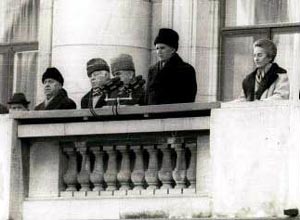 Nicolae's last speech on state TV
 People marching in the streets of Bucharest
Besides announcing the victorious march to Palace Square, the occupation of the Central Committee building and the fleeing of Nicolae and his underlings, the dissidents used television as a stage to exhibit the enemies of the state, including Nicu Ceausescu, Nicolae's son and a bloodied man who was accused of trying to sneak into the TV station and assassinate the leaders responsible for the coup.
 The protestors
 Victory!
When 'terrorist forces', armed units still loyal to Nicolae attacked the vital points of socio-political life: the television, radio, and telephone buildings, the prostestors holed up in the TV station were quick to react by urging the public not to worry and stated that the 'army will protect us'. When Bucharest practically turned into a warzone, state television aired scenes where soldiers were fighting valiantly against subversive elements with the aid of civilians, thus boosting the morale of countless others who barricaded themselves at home.
 The military and the people
After hostilities finally ended on 27th December 1989, the new and improved Românǎ de Televiziune (TVR) run by the new regime took the opportunity to parade their most valuable catches to date: Nicolae and Elena Ceausescu themselves! After failing to flee the country, they were caught by the people and the military and tried in a kangaroo court. After conviction and execution, their corpses were filmed and aired live to every working televsion set in Romania to the delight of everyone who was watching. They applauded the deaths of the infamous couple and hoped that the new year would usher in a prosperous new future for all Romanians and generations to come.
 Working together against the enemy
In conclusion, television in Romania during that volatile period was totally different from the one we are used to watching. There were no rehearsed scripts, no actors, no propaganda for that matter. Only the truth was shown the moment communism collapsed in the impoverished state; the moment when that helicopted took off carrying Nicolae and Elena with it. All in all, television gave the opportunity to Romanians to be a part of history and to feel for themselves what it meant to be free once more from the grip of tyranny. For the millions more who did not take to streets of Bucharest, it did not mean they could not sing and cheer together with those who fought and died in the name of democracy. That, my friends, could not have been made possible without the help of television.
 Nicolae takes flight
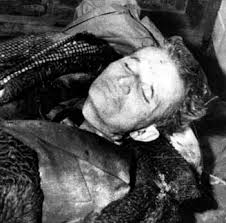 Nicolae on TV for the last time
P.S.: I found a video of Nicolae and Elena on trial in the kangaroo court, with audio! Now we can listen to how he actually defended himself.
Read more...


Subscribe to:
Posts (Atom)